Table of Contents
So, your microwave dies while re-heating last night’s rice and beans. Your kid’s shoes magically don’t fit again. And your car decides today’s the day to make that funny noise.
Life’s little surprises don’t wait for payday.
And if you’re not saving money for rainy day moments, those “small” problems start wrecking your budget like a wrecking ball in a rom-com.
I’m not here to scare you — but I am here to help you get ready. Because these little expenses? They will happen. And when they do, you’ll either have a stash that covers it… or you’ll be pulling out your credit card and praying.
And listen — as someone who loathes debt with the fire of a thousand suns (especially store card debt… don’t even get me started), I can tell you this:
Rainy day savings are not optional. They’re essential.
Let’s break down:
- What a rainy day fund actually is
- Why you need one separate from your emergency fund
- How much to save
- And how I helped my sister stash over $700 in 30 days — all because I forced her to take budgeting seriously (she survived, don’t worry)
So, What Is a Rainy Day Fund?
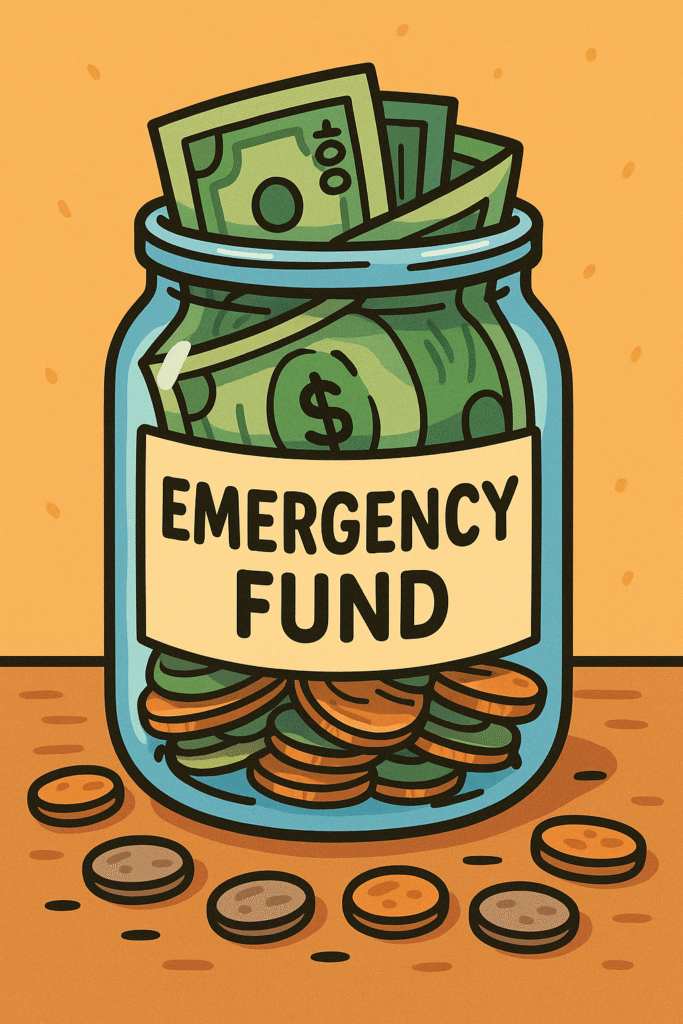
A rainy day fund is your “ugh, of course that happened” money. It’s not for emergencies. It’s for life’s random chaos.
Like:
- You need new tires
- Your kid’s school wants $60 for a “surprise” field trip
- Your best friend decides to get married and you gotta buy a gift and a dress
- The dog eats something weird and ends up at the vet
None of this is life-shattering. But it is budget-shaking if you don’t have money set aside.
When you’re saving money for rainy day things, you’re basically building a safety net for all the stuff you forgot to plan for.
Why You Can’t Just Use Your Emergency Fund for Everything
I know what you’re thinking: “Can’t I just use my emergency fund for stuff like this?”
Short answer? No.
Emergency funds are for full-blown chaos:
- Job loss
- Medical crisis
- The car engine gives out and you’re stuck on the highway
- You need to fly cross-country last minute
Rainy day funds are for the out-of-nowhere purchases. The annoyances. The budget curveballs. If you keep using your emergency savings for every little thing, it’ll never grow — and worse, it won’t be there when the big stuff actually hits.
You need both. They serve two totally different purposes.
Here’s How I Built an Emergency Fund Over $30K (While Still Saving for Rainy Days)
So this isn’t theory — this is what I actually did.
After my husband and I bought land in the Dominican Republic, I locked in like a woman on a mission. Tunnel vision.
We saved $18,000 in one year on one income, and I kept going.
Now? My emergency fund is sitting at over $30,000. Is it technically my “house fund”? Yes. But I also treat it like a last resort. Why? Because:
You never know what could happen.
Life doesn’t send calendar invites for chaos. I’d rather be overly prepared than back in debt.
But here’s the thing — while I built that emergency stash, I still kept a smaller fund for all the “life just be life-ing” moments.
The Real-Life Rainy Day Win: My Little Sister’s Budget Glow-Up
When I started helping my youngest sister with her budget, she had a $1,000 store card maxed out and no savings. (Insert scream here.)
I told her she was going to pay that card off first — period. No “but what ifs.” No debates.
She looked at me like I asked her to donate a kidney.
But guess what?
After we set her up with a budget, she paid that card off and saved over $700 in one month.
Why? Because she stopped swiping, started tracking, and focused.
She made her own rainy day fund — and the peace she felt? Chef’s kiss.
I hate debt so much — especially store cards. 29% interest for 10% off your purchase? Absolutely not.
Rainy day saving keeps you from falling back into that trap.
How Much Should You Save for a Rainy Day Fund?
Let’s make it simple:
- Minimum goal: $500
- Sweet spot: $1,000 to $2,000
- If you’ve got kids/homeownership: Push it toward $2,000+
You’re not building an empire here — you’re just making sure a broken appliance or car repair doesn’t wreck your whole month.
Where to Keep Your Rainy Day Fund
You’ve got a few solid options:
- A labeled savings account (separate from your main savings)
- A cash envelope (if you’re a hands-on kind of girl)
- Sinking fund categories in your budget (like “Car Maintenance,” “Home Repairs,” or “Kid Stuff”)
Just don’t keep it so accessible that you dip into it for nonsense. You know what I’m talking about — that “Oops, I was just checking Target for one thing” type of dip.
How to Start Saving Money for Rainy Day Stuff (Even If You’re Broke-ish)
1. Start Small and Stay Consistent
$10 a week. $25 a paycheck. A handful of fives in an envelope.
You’re not trying to hit $1,000 tomorrow. You’re building a habit. A cushion. A way out of panic-spending.
2. Use What You Already Spend (Just Smarter)
Look at your:
- Subscription services you forgot to cancel
- Weekly takeout habit
- Random Target/Marshalls/Amazon runs (for me? Dollar Tree haha)
Trim one or two of those, and that’s your rainy day fund money right there.
3. Automate It
If you’re like me, “I’ll transfer it later” turns into “I spent it already.”
So automate it. Set up a recurring transfer into your rainy day account. Even $15 on payday makes a difference.
4. Turn It Into a Challenge
Make it fun! Saving money doesn’t have to feel like punishment. Turn it into a challenge and suddenly, it’s low-key addicting.
- Try a 30-day rainy day savings challenge
- Stash every $5 bill you come across
- Pick one weekend a month to go full-on No Spend Mode
If you’re like me and need visuals, structure, or just something to keep you from quitting halfway through — I got you.
You can grab my Savings Challenges and No Spend Workbook — print it out, pick your favorite challenge, and start crossing off boxes like a boss. No stress. No spreadsheet drama. Just a simple way to stay on track without falling asleep mid-budget.
Whether you’re saving $1 or $100 at a time, this is the stuff that makes it stick.

Rainy Day Fund vs Emergency Fund (Just So We’re Clear)
Here’s your cheat sheet:
| Rainy Day Fund | Emergency Fund |
| Small, annoying stuff | Big, overwhelming life stuff |
| $500–$2,000 | $1,000–$30,000+ |
| Used more often | Used rarely |
| Easier to access | Keep locked up |
| Prevents debt buildup | Prevents total financial collapse |
You need both. But rainy day saving is the one you’ll use more often — and the one that’ll save your sanity over and over again.
In Conclusion: Save Now, Chill Later
Saving money for rainy day surprises isn’t just “a good idea” — it’s a must.
Because life will test you. Stuff will break. Fees will pop up out of nowhere.
You’ve got two choices:
- Be caught off guard and swipe your way into stress
- Or be the one who calmly grabs the cash and keeps it moving
You don’t need a fancy spreadsheet. You don’t need to be perfect.
You just need a plan, some consistency, and a little fire under your budget.
Start with $500. Then $1,000. Make it non-negotiable.
Use challenges, envelopes, whatever works for your brain and lifestyle.
This is what actually worked:
- I built a $30k emergency fund on one income
- I helped my sister save $700 in 30 days
- I walked away from debt, and stayed out with a rainy day fund as my backup dancer
And listen — if I can do this while juggling kids, work, and reheating the same coffee three times, so can you.
Grab your free Emergency Fund tracker below to make your rainy day stash real — because adulting without one? That’s the real emergency.
